1
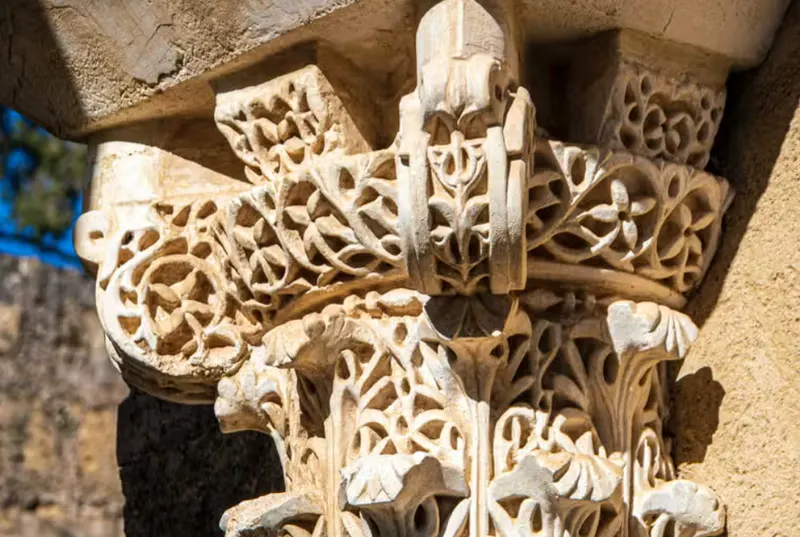
Welcome to Al-Andalus. This marble capital is a good starting point because it sums up, in a single block of stone, everything that Córdoba was in the tenth century: the largest and most cultured city in Europe, the head of a caliphate that stretched from the Duero to North Africa, and the capital of a civilisation that spoke Arabic, prayed in three religions and read the Greek philosophers when the rest of the continent had forgotten them.
First, look at the texture. The Andalusi stonemasons carved the marble with an instrument called a drill, which pierces and heats the stone until it becomes a kind of lace. Specialists call this technique the "wasp's nest capital", because of the hollows that look like the holes of a beehive. The idea is not only to decorate: it is to let light pass through the capital, so that the stone seems light, almost textile. The caliph's power is not shown with a solid capital, but with one that breathes.
This piece comes from Medina Azahara, a palace city that the caliph Abd al-Rahman III ordered to be built on the outskirts of Córdoba around the year 936. It was an administrative and ceremonial capital designed to dazzle the ambassadors arriving from Constantinople, from Baghdad, from the Christian kingdoms of the north. Chronicles of the time tell of pools of mercury in the courtyards, golden ceilings and doors that closed by hydraulic mechanisms. It lasted barely seventy years. In 1010, amid a civil war within the caliphate itself, Medina Azahara was looted and then forgotten. For centuries, the local peasants simply called it "the old ruin".
Think for a moment about what that means for us here in Colombia. While Europe was still counting its days in dark centuries, Córdoba had a library of four hundred thousand volumes, street lighting, hospitals and a university. The language of that university was not Latin: it was Arabic. The science taught there, such as algebra, astronomy and medicine, had been written in Arabic for several centuries, and from Córdoba it would pass, translated, to the rest of the world. Many words we use every day in Colombia come from that Andalusi Arabic: "azúcar", "almohada", "alcalde", "alcancía", "aceite", "ojalá". Every time we say "ojalá", from the Arabic in shā' Allāh, "God willing", we are, without knowing it, quoting Córdoba.
The capital in front of you probably supported, a thousand years ago, a column in the hall where the caliph received foreign envoys. After that hall came looting, neglect and the archaeological excavation of the twentieth century. And after all of that, this capital arrived in Bogotá.
When you have finished listening, move on to the display case on the left, where a small ivory casket awaits you, which belonged to the most powerful woman of the caliphate.